Former Vice President Kalonzo Musyoka has appointed Nyali Member of Parliament Mohamed Ali as the Wiper Deputy Party Leader.
The announcement was made on Friday, August 7, during a ceremony at the Wiper Party Headquarters in Nairobi.
Kalonzo said Ali was well-suited for the role, citing his background as an investigative journalist and his track record in the fight against corruption.
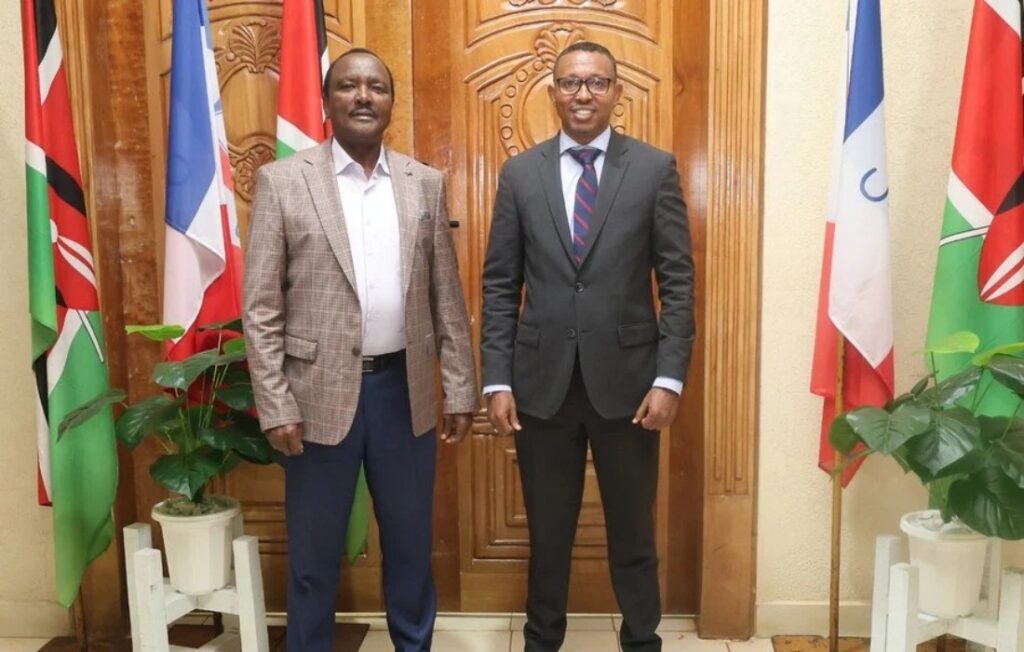
Wiper Leader Kalonzo Musyoka with Nyali MP Mohamed Ali. Photo: Courtesy.
He praised the MP’s dedication to protecting public funds in the National Assembly, noting that Ali had recently been ranked as the 10th best-performing lawmaker in the country.
The Wiper leader described Ali as a leader of integrity who cannot be bought or intimidated. He added that Ali’s commitment to exposing wrongdoing and serving the public had remained strong throughout his political career.
As Chairman of the Finance Committee on the Parliamentary Service Commission, Ali continues to guard public resources with the same discipline he once applied to journalism.
Kalonzo also stated that Ali represents not only the Coast Region but also young leaders who want to live in a country that values integrity over patronage.
In a separate announcement, Kalonzo appointed Advocate of the High Court Ndegwa Njiru as the new Wiper Patriotic Front Spokesperson.
Njiru becomes the first person to hold this newly created office, which the party established for what Kalonzo described as a new struggle.
The Wiper leader noted that Njiru has a strong record of defending ordinary Kenyans against abuse of power.
Kalonzo also addressed concerns about disunity among opposition leaders.
He maintained that the coalition remains united despite recent public disagreements between some of its leaders.
He described division as the government’s only strategy and urged Kenyans not to take the verbal clashes too seriously, insisting that the opposition stands together.
Turning to electoral matters, Kalonzo questioned IEBC Chairperson Erastus Ethekon over recent claims that the Commission could not conduct elections under the current environment.
He argued that the Constitution only allows the IEBC to postpone elections in areas affected by specific security threats, not to cancel or delay an entire national election.