
President William Ruto has officially signed the National Infrastructure Fund Bill, 2026 into law.
The Head of State assented to the legislation on Monday, March 9, during a ceremony held at State House in Nairobi.
The signing ceremony was attended by several senior government officials, including National Assembly Speaker Moses Wetang’ula, Majority Leader Kimani Ichung’wah, Treasury Cabinet Secretary John Mbadi, Treasury Principal Secretary Chris Kiptoo, and Kamau Thugge.
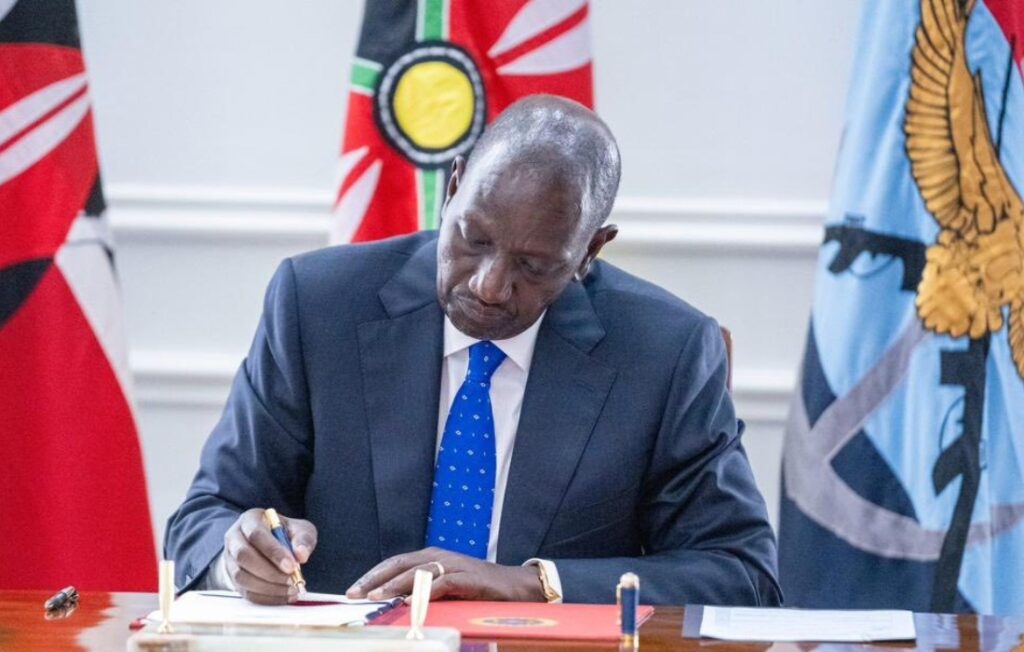
New National Infrastructure Fund Becomes Law. Photo: Courtesy.
The development comes just days after the National Assembly of Kenya approved the National Infrastructure Fund Bill, 2026, which was sponsored by Ichung’wah.
The newly enacted law seeks to mobilize KSh5 trillion to support infrastructure development, shifting Kenya’s financing strategy from a debt-heavy model to a more sustainable investment-driven approach.
The new law establishes the National Infrastructure Fund (NIF), which will mobilize financing for major development projects across key sectors such as transport, energy, water, irrigation, and digital connectivity.
The fund will also support the construction and expansion of highways, railways, ports, agribusiness infrastructure, and other strategic national projects.
Under the law, the NIF will operate as a corporate entity with the authority to enter into contracts, borrow funds, and acquire, manage, or dispose of both movable and immovable property.
Most of the fund’s capital is expected to come from infrastructure financing sources, including domestic pension funds, collective investment schemes, sovereign wealth funds, and climate finance.
The NIF will be overseen by a Board of Directors alongside a Chief Executive Officer (CEO).
The board will be responsible for mobilizing resources for the fund by investing in infrastructure projects and entering into agreements on its behalf.
Additionally, the fund will be allowed to invest directly in viable projects through equity participation or debt financing, depending on the bankability of the projects.
However, the board will not have the authority to borrow funds or use the NIF’s balance sheet as collateral.
The National Infrastructure Fund Act also includes strict safeguards to prevent mismanagement and political interference.
The fund will undergo both internal and independent external audits. The Board of Directors is required to establish an audit committee to supervise internal audits and coordinate with external auditors.
All audit findings will be submitted to the Cabinet Secretary for the Treasury, who is responsible for making the reports publicly accessible.