

Kenya and Rwanda have signed three agreements that will enable Rwanda to import bulk refined petroleum products through the Port of Mombasa under a Government-to-Government (G2G) framework, a move expected to significantly increase fuel volumes transported via Kenya’s Northern Corridor.
The agreements, signed on Monday, June 29, at KASNEB Tower in Nairobi, comprise a Memorandum of Understanding (MoU), a Tripartite Agreement (TPA), and a Transport and Storage Agreement (TSA).
Together, they establish the legal and operational framework for Rwanda’s bulk petroleum imports through Kenya.
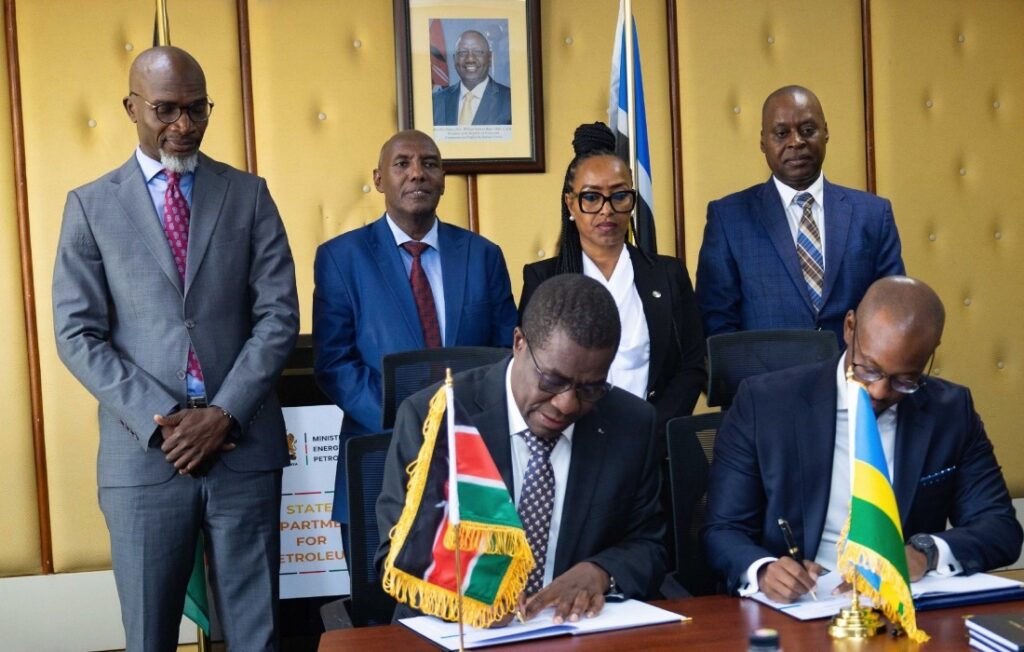
Kenya, Rwanda signing deal. Photo: Courtesy.
The signing concludes negotiations that began during a bilateral meeting in Kigali in November 2024.
Kenya’s Cabinet approved the framework on June 16, 2026, clearing the way for its implementation.
Under the arrangement, Rwanda’s annual petroleum imports through the Northern Corridor are expected to rise from about 42,000 cubic metres in 2025 to more than 500,000 cubic metres.
The first shipment under the new framework, designated RNEC 001/2026, is scheduled to arrive at the Port of Mombasa between September 4 and 6, 2026.
Energy Cabinet Secretary Opiyo Wandayi said the agreements represent a long-term commitment by Kenya to guarantee a secure and reliable transit route for Rwanda’s petroleum supplies.
He noted that the projected increase in fuel volumes reflects not only expanded trade but also deeper economic integration between the two countries, with broader benefits for the East African Community and the Great Lakes region.
Rwanda’s Minister of Trade and Industry Antoine-Marie Kajangwe said the framework would enhance Rwanda’s energy security by ensuring reliable, affordable, and secure access to petroleum products.
He added that the agreements reflect the strong partnership between the two countries and expressed optimism ahead of the arrival of the first cargo in September.
Kenya Pipeline Company (KPC) Acting Managing Director Pius Mwendwa said the deal marks a significant milestone in efforts to reclaim a larger share of Rwanda’s petroleum market.
He noted that KPC had spent years working with the Ministry of Energy and Petroleum and the Energy and Petroleum Regulatory Authority (EPRA) to expand its presence in Rwanda, where it had previously supplied only a small portion of the country’s fuel demand.

