
The Iranian government has assured that Kenya is not at risk from the ongoing missile attacks linked to escalating tensions with the U.S. and Israel that have affected Gulf countries.
Speaking to the press on Monday, March 2, Iranian Ambassador to Kenya, Ali Gholampour, explained that Kenya does not host any U.S. military facilities capable of targeting Iran.
He also confirmed that Iran is using short-range missiles, which cannot reach Kenyan territory, emphasizing that the country’s actions are defensive in nature.
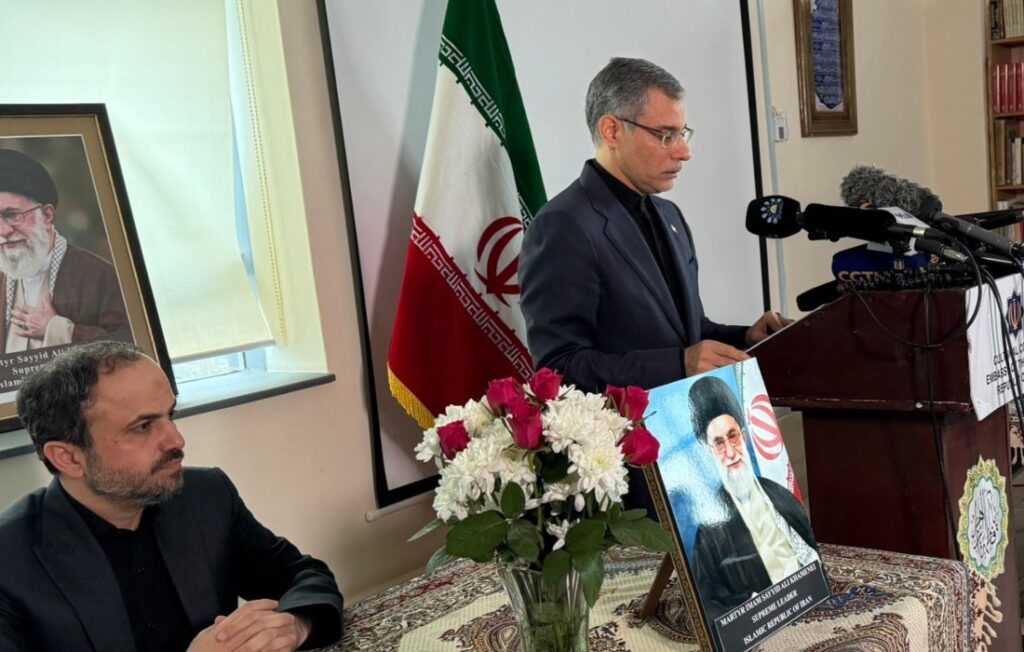
Iran Reassures Kenya as Missile Attacks Escalate in Middle East. Photo: Courtesy.
“Our missiles will not reach the Kenyan territory. Our government has deliberately, in order to show its intention, a peaceful intention, limited the range of missiles only for defensive purposes.Iran will not target Kenya…Kenya doesn’t provide a U.S. military facility with a magnitude to attack Iran.”
The United States maintains a sustained military presence in Kenya under a strategic partnership centred on regional security and counterterrorism efforts.
Its most notable installation is Camp Simba, located within the Kenyan-owned Navy Base Manda Bay in Lamu County, which serves as a key operational hub for U.S. Africa Command (AFRICOM) in missions targeting extremist groups such as Al-Shabaab.
While reiterating that Kenya is not a direct target, Iranian Ambassador Ali Gholampour acknowledged that the ongoing conflict could negatively impact Kenya and other African nations through disruptions to critical trade routes and commercial transport corridors.
He called on the United Nations and other international bodies to spearhead negotiations, uphold international law, and work toward securing a ceasefire, maintaining that Iran’s actions are defensive following what it views as external aggression.
President Ruto on the other hand has strongly condemned Iran’s recent attacks targeting Gulf nations, including the United Arab Emirates, Qatar, Saudi Arabia, Iraq, Oman, Kuwait, Jordan, and Bahrain, warning that the widening conflict risks undermining international peace and security.
In a statement shared on his official social media platforms on Monday, March 2, the Head of State emphasized that the growing regional dimension of the crisis poses a serious global threat.
Ruto underscored the importance of multilateral diplomacy, noting that longstanding international institutions remain critical in managing tensions and steering the Middle East crisis toward de-escalation and stability.